Español
 عربى
 Deutsch
 русский
 Français

A 1-inch brass strainer valve was installed on a rooftop chilled-water bypass line. The maintenance team chose a 40-mesh screen, pointed the screen leg upward to clear a ceiling obstruction, and skipped the blowdown port because “there was no room.” Six weeks later, a coil fouled with rust flakes and thread tape. The strainer body was fine. The specification and installation were not.
That is the short version: a strainer valve is a small protective component with an outsized ability to prevent downtime, but only when the screen, body, orientation, and maintenance access match the duty. Size alone is not a specification. A strainer that is one pipe size larger than needed, fitted with the wrong mesh, or installed with the screen leg in the wrong direction can create more problems than it solves.
This guide is written for buyers, installers, maintenance leads, and engineers who need to choose a strainer valve that works in real plumbing, HVAC, water-metering, steam, and light industrial systems. It covers what a strainer valve does, how a Y-pattern strainer works, how to select mesh and body material, what pressure drop tells you, how orientation changes performance, and which procurement details prevent callbacks.
What a Strainer Valve Does and Does Not Do
In many catalogs, “strainer valve” describes an inline strainer with a removable screen, usually a Y-pattern body, installed to protect downstream valves, pumps, meters, coils, and nozzles. Some products combine a ball valve and a Y-screen in one body, which can save a joint and simplify isolation. The same selection logic applies: the screen must capture the debris you care about without creating an unacceptable pressure drop or a maintenance trap.
A strainer valve is not a control valve. It does not regulate flow, balance a circuit, or stop backflow. It is also not a fine filter. A standard Y-strainer removes visible debris such as pipe scale, solder particles, thread tape, gasket fragments, and construction grit. It does not remove dissolved minerals, chlorine, bacteria, or fine silt that passes through the screen aperture. If the system needs fine filtration or water treatment, a strainer is a prefilter or a protective device, not a replacement.
The distinction matters at purchase. A buyer who asks only for “a 1-inch brass strainer valve” may receive a body with a coarse 20-mesh screen, a fine 80-mesh screen, a blowdown port, or no drain at all. Those versions behave differently. A coarse screen may pass debris that damages a meter. A fine screen may clog quickly and starve a coil. A strainer without a drain port may require disassembly for every cleaning. The specification has to name the duty, not just the pipe size.
A strainer also has a maintenance cost. Every screen creates resistance. As debris accumulates, pressure drop rises and flow falls. That is useful as an indicator if someone is watching the gauge, but it is harmful if the strainer is buried above a ceiling or installed without isolation valves. The best strainer valve is not the one with the largest screen area on paper; it is the one that can be cleaned safely, quickly, and often enough for the debris load in that line.
Anatomy of a Y-Pattern Strainer Valve
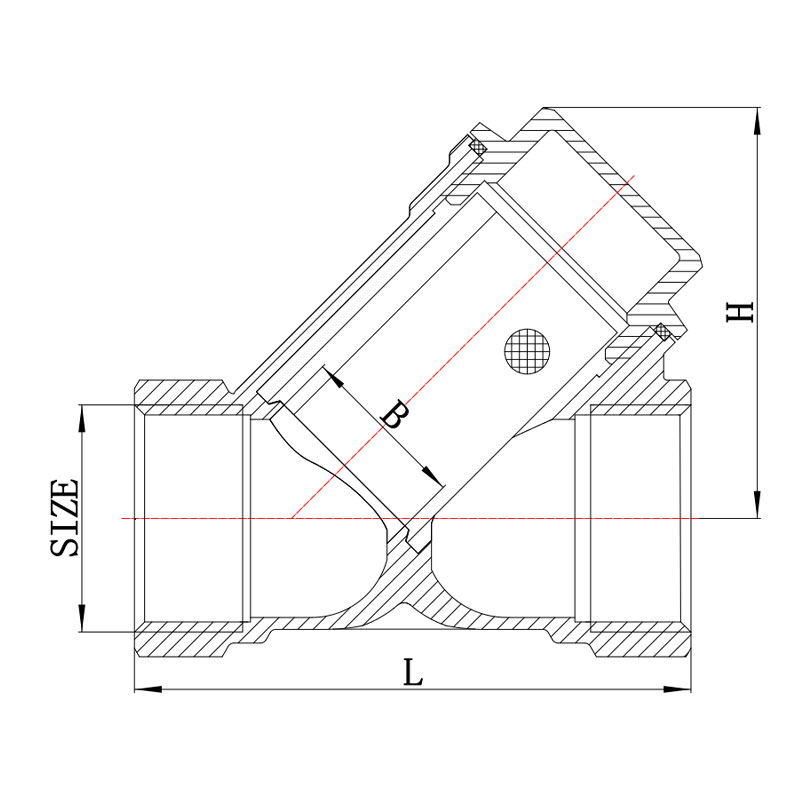
A typical Y-pattern strainer has a body with a straight flow path and an angled branch that holds the screen. The screen is a cylindrical or conical basket retained by a bonnet, cap, or threaded plug. Fluid enters the body, passes through the screen from the outside in or inside out depending on the design, and exits to the downstream line. Debris collects in the screen or in the lower pocket. A blowdown port, if fitted, allows a technician to purge loose material before removing the bonnet.
The important details are often invisible in a catalog photo. The screen retention method should prevent bypass around the screen edges. The bonnet gasket should be replaceable and suitable for the fluid and temperature. The body should have a clear flow arrow. The screen should be supported so it does not collapse under differential pressure. The drain port should be plugged or valved in a way that allows safe cleaning. A strainer that leaks at the bonnet after the first cleaning is usually a gasket, thread, or torque problem, not a mysterious manufacturing defect.
Connection style is part of the anatomy because it controls installation and service. Threaded strainers are common in small water and HVAC lines. Flanged strainers suit larger pipe sizes and applications where a bolted joint is preferred. Press, compression, and PEX connections appear in plumbing systems where speed and joint consistency matter. The connection must match the pipe standard, thread form, and sealing method. A BSP thread and an NPT thread look similar to an untrained eye and will not seal correctly together.
A compact threaded brass Y-strainer such as the GH5001 is a common starting point for small water lines where the screen leg can point downward and the bonnet remains accessible. It is not a universal answer for every line. The same body style may be wrong for a high-chloride cooling loop, a steam line with heavy condensate, or a flanged header that needs a specific face-to-face dimension.
 GH5001 Brass Threaded Y-Strainer for Small Water LinesCompact threaded brass Y-strainer for small water lines, with accessible screen and 1/2–2 in. sizes; verify fluid and line suitability.View Product →
How It Works and Why Pressure Drop Matters
A clean screen has open area, but it still changes the flow path. The pressure drop across a clean strainer depends on flow rate, viscosity, screen aperture, open area, body geometry, and connection size. A dirty screen adds resistance as debris blocks the openings. In a pump suction line, that resistance can contribute to cavitation. In a gravity system, it can reduce flow. In a metering line, it can cause erratic measurement or low pressure at the meter.
Do not size a strainer by pipe diameter alone. Two 1-inch strainers can have different screen areas, different Cv values, and different pressure drops at the same flow. A compact Y-pattern body with a small screen may be fine at 5 gpm and unsuitable at 20 gpm. A flanged body with a larger screen chamber may handle more flow but take up more space. The purchase decision should include the expected flow, the allowable clean pressure drop, and the expected dirt load.
Pressure drop is also a maintenance signal. Install pressure gauges upstream and downstream, or at least provide gauge ports, on strainers that protect critical equipment. Record the clean differential pressure after commissioning. Then set a cleaning threshold based on the system. Many maintenance teams use a rise of roughly 5 to 10 psi above the clean baseline, but that is not a universal rule. A small metering line may need a tighter threshold. A large low-pressure water line may tolerate more. The supplier’s data and the equipment manufacturer’s limits should govern.
A strainer that is clean but still has high pressure drop may be undersized, installed backward, fitted with a finer screen than intended, or fitted with a screen that has less open area than the original. A strainer that has low pressure drop but still allows downstream damage may be bypassing flow around the screen, using a mesh that is too coarse, or missing a gasket or screen support. Pressure drop tells you something is happening; it does not tell you everything.
Common Strainer Valve Types and Where They Fit
The Y-pattern strainer is popular because it is compact, inexpensive to service, and available in many materials and connections. It is not the only option. Basket strainers offer more screen area and are easier to clean in some large lines. Duplex strainers allow screen changes without stopping flow, which matters in continuous processes. Temporary start-up strainers protect new pipework during flushing and are then removed. An angle strainer can solve a corner or vertical-run problem. A ball valve with an integral Y-screen combines isolation and debris capture, but the buyer must check whether the screen can be serviced without removing the whole valve.
| Style | Typical fit | Watch-outs |
|---|---|---|
| Y-pattern strainer | Small to medium water, HVAC, steam, and plumbing lines; threaded or flanged connections | Limited screen area in compact bodies; orientation and bonnet access matter; fine mesh clogs quickly |
| Basket strainer | Higher dirt loads, larger pipe sizes, and applications where a larger screen chamber is acceptable | Larger footprint; basket removal clearance; gasket and lid condition |
| Duplex strainer | Continuous flow where the screen must be changed without shutting down | Higher cost and complexity; bypass valve discipline; larger installation space |
| Temporary start-up strainer | Flushing new pipework before commissioning | Must be removed after flush; not a substitute for permanent protection |
| Integral strainer ball valve | Small isolation points where debris protection and shutoff are both useful | Check Cv, screen serviceability, and whether the screen can be replaced without replacing the valve |
The practical question is not “Which strainer is best?” It is “Which strainer can this line live with?” A permanent Y-strainer on a dirty construction line may need daily cleaning until the system is flushed. A basket strainer may be better where the debris volume is high. A duplex strainer may be justified where a shutdown costs more than the hardware. A temporary start-up strainer may be the correct choice if the system is expected to run clean after commissioning.
Materials and Wetted-Part Choices
Brass and bronze are common strainer body materials in water, HVAC, and light industrial service. Brass is widely used for threaded plumbing components because it machines well and accepts nickel plating. Bronze is often selected where higher chloride exposure, seawater, or dezincification risk makes ordinary brass less comfortable. Stainless steel suits more aggressive fluids, higher temperatures, or applications where iron contamination and corrosion products are unacceptable. Cast iron can be adequate in some large low-pressure water systems, but uncoated cast iron is not a default choice for potable water or aggressive service.
The screen material deserves equal attention. A brass body with a stainless steel screen is common, but “stainless” is not a single grade. Type 304 stainless is adequate in many clean water applications. Type 316 stainless is more resistant to chlorides and is often preferred in coastal, marine, or chemical environments. The gasket must also match the fluid and temperature. A gasket that swells in hot water or hardens in steam will leak at the bonnet, even if the body and screen are correct.
Nickel plating is a surface finish, not a material upgrade. It can improve corrosion resistance and appearance, and it is common on brass valves and fittings. It does not turn a brass body into bronze, and it does not make a low-pressure component suitable for a high-pressure line. Buyers should ask what the base alloy is, what the plating thickness or specification is if relevant, and whether the wetted materials comply with local potable-water rules. For potable water, lead content and alloy compliance must be documented, not assumed from the word “brass.”
Where dezincification resistance, marine exposure, or high-humidity service matters, a bronze Y-pattern strainer such as the GH5003 is often specified instead of ordinary brass. Bronze is not automatically immune to every fluid, so the fluid chemistry and temperature still need to be checked against the supplier’s data. The point is to choose the alloy for the water, not to choose the most expensive label.
 GH5003 Bronze Y-Strainer for Marine and Corrosive ServiceBronze Y-strainer with removable stainless steel basket for saltwater, chloride, and high-humidity lines; confirm fluid chemistry and temperature before selection.View Product →
Sizing the Strainer Valve: Flow, Mesh, and Open Area
Sizing starts with the duty. Write down the fluid, flow rate, temperature, operating pressure, pipe size, connection standard, allowable pressure drop, expected debris, cleaning frequency, and whether the line can be isolated. Then choose a body and screen that meet those conditions. A strainer selected only by nominal pipe size may fit the pipe and still fail the duty.
Mesh selection is a balance between capture and clogging. A finer screen captures smaller particles but has smaller openings and less free area, so it loads faster and creates higher pressure drop. A coarser screen protects against large debris but may pass particles that damage a meter, nozzle, or pump. The right mesh is the coarsest screen that protects the downstream equipment without creating an unreasonable cleaning burden.
| Mesh size | Approximate opening | Typical use | Risk |
|---|---|---|---|
| 20 mesh | About 0.84 mm | General debris, larger pipe scale, pump protection during start-up | May pass fine grit and small thread fragments |
| 40 mesh | About 0.42 mm | General plumbing and HVAC protection | Clogs faster than 20 mesh; not fine enough for every meter or nozzle |
| 60 mesh | About 0.25 mm | Smaller debris control ahead of meters, small valves, and nozzles | Higher pressure drop; frequent cleaning may be needed |
| 80 mesh | About 0.18 mm | Fine protection in clean systems | Rapid clogging in dirty systems; verify available pressure |
Open area matters as much as mesh number. A 40-mesh screen with a large cylindrical basket can have more open area than a 40-mesh screen in a compact body. That affects pressure drop and cleaning interval. If the line has a high dirt load, consider a larger body, a basket style, or a duplex design rather than simply choosing a coarser screen. If the downstream equipment is sensitive, consider a finer screen plus a differential pressure gauge and a realistic cleaning schedule.
On flanged lines where the strainer must match a fixed bolt pattern and be removed without disturbing welded pipe, a flanged brass Y-strainer such as the GH5002 is a practical starting point. The flange standard, face-to-face dimension, gasket surface, and bolt size still need to be confirmed against the line. A flanged body that does not match the mating flange is not a bargain; it is a shutdown.
 GH5002 Brass Flanged Y-Strainer for Fixed Pipeline ConnectionsFlanged brass Y-strainer for lines needing a fixed bolt pattern and removable body; confirm flange standard, face-to-face dimension, and flow direction.View Product →
Installation: Orientation, Isolation, and Bypass
Read the flow arrow before the wrench turns. A Y-strainer installed backward may still pass water, but the screen will not protect the downstream equipment as intended. The debris may collect on the wrong side of the screen, the screen may distort, and cleaning may not remove the material that matters. The arrow is not decorative.
Orientation depends on the line and the design. In a horizontal line, the common practice is to point the screen leg downward so debris settles into the screen pocket and the bonnet is accessible from below. In a vertical line, follow the manufacturer’s instruction. Many Y-strainers are intended for downward flow through the screen leg; an upward-flowing vertical line can make debris fall back into the pipe or make the screen difficult to drain. If the only available vertical run flows upward, use an angle or basket strainer designed for that orientation, or create a spool that allows the correct position.
Provide isolation. A strainer without an upstream and downstream valve is a maintenance problem waiting for a shutdown. If a bypass is installed, it must be controlled so it cannot be left open and unnoticed. A bypass that lets debris bypass the screen defeats the purpose. If the bypass is used for cleaning, use a locked valve or a procedure that requires confirmation before normal flow is restored.
Install a blowdown valve on the drain port where the design allows it. A blowdown is not a substitute for removing and cleaning the screen, but it can remove loose debris and extend the interval between bonnet removals. Point the blowdown outlet to a safe location. Do not let it discharge onto walkways, electrical equipment, or hot surfaces.
Support the pipe, not the strainer. A strainer body is not a pipe hanger. Excessive torque on threaded connections, misaligned flanges, and unsupported weight can crack bodies or distort gaskets. Use the correct thread sealant and avoid excess tape or paste that can enter the line and load the screen. On new systems, install a temporary start-up screen, flush the line, and then replace it with the permanent screen. Do not leave a construction screen in place indefinitely because it was convenient.
Maintenance and Troubleshooting
Strainer maintenance is simple when the installation allows it and painful when it does not. Isolate the strainer, depressurize the line, drain it, and confirm that the downstream side is isolated before opening the bonnet. Remove the screen, inspect it for holes, collapsed areas, and embedded debris, and clean it in a way that does not damage the weave. Replace the bonnet gasket if it is compressed, hardened, or damaged. Reassemble to the supplier’s torque guidance, then leak-test and restore flow.
Record the clean differential pressure after every cleaning. That baseline is more useful than a guess. If the pressure drop rises faster than expected, the cause may be construction debris, corrosion products, thread sealant, scale, or a screen that is too fine for the dirt load. If the pressure drop is low but downstream equipment still fouls, the screen may be bypassing flow, the mesh may be too coarse, or the debris may be passing through in a dissolved or fine form that the strainer cannot capture.
The same hygiene applies to the surrounding pipework; this brass plumbing pipe installation and maintenance guide is a useful cross-check for flushing, jointing, and support practices. A strainer cannot compensate for a dirty installation or a pipe system that continues to generate debris.
| Symptom | Likely cause | Practical action |
|---|---|---|
| High pressure drop shortly after cleaning | Heavy debris load, wrong mesh, undersized body, or low open area | Check baseline, inspect screen, consider larger body or coarser mesh, investigate the source of debris |
| Low pressure drop but downstream damage | Screen bypass, backward installation, missing gasket, or coarse mesh | Verify flow arrow, screen seating, gasket, and aperture; inspect the downstream component |
| Leak at bonnet | Damaged gasket, insufficient torque, over-torque, or thread damage | Replace gasket, inspect threads, torque to supplier guidance, leak-test |
| Screen collapsed or distorted | Excessive differential pressure, unsupported screen, or water hammer | Increase open area, use a reinforced screen, check flow and valve operation |
| No debris in screen but recurring clogging | Scaling, sediment, or fine particles passing the mesh | Check water chemistry, add appropriate treatment or finer filtration, not just a finer strainer screen |
Do not solve every problem with a finer screen. A finer screen can increase pressure drop, shorten cleaning intervals, and create a false sense of protection if the real problem is corrosion, scaling, or construction debris. Sometimes the correct fix is to flush the system, change the pipe material, add a filter, or relocate the strainer to a place where it can be maintained.
Applications Where Strainer Valves Earn Their Keep
In potable water and water-metering lines, a Y-strainer ahead of a meter protects the measuring chamber from scale, thread tape, and pipe debris. It should be selected with potable-water-compliant wetted materials and a mesh that protects the meter without creating excessive pressure drop. A check valve downstream may protect against backflow, but it does not replace the strainer. The strainer catches debris; the check valve controls direction.
In HVAC chilled-water and hot-water systems, strainers protect coils, control valves, balancing valves, and pumps. A strainer on a coil branch can catch debris before it reaches a narrow passage. A strainer on a pump suction line needs careful sizing because excessive pressure drop can contribute to cavitation. In many new systems, a temporary start-up strainer is used during flush and then removed or replaced with a permanent screen. Leaving a fine start-up screen in service can create a chronic low-flow problem.
In steam systems, strainers protect traps, control valves, and steam-using equipment from scale and pipe debris. Installation details matter: provide a blowdown, orient the screen leg so condensate and debris can collect, and follow the manufacturer’s limits for steam service. A strainer that is acceptable for cold water may not be acceptable for saturated steam at the same nominal size.
In irrigation and outdoor water systems, strainers protect valves, drip emitters, and nozzles from sand and organic debris. A coarse screen may be enough for large debris, but fine emitters may need finer filtration. In coastal or high-chloride environments, bronze or stainless components may be more appropriate than ordinary brass. In marine and seawater service, material selection and maintenance frequency become more important than the initial price.
In light industrial fluid lines, strainers protect pumps, meters, heat exchangers, and spray nozzles. The fluid may be water, a water-glycol mix, a mild chemical, or a food-grade liquid. The body, screen, and gasket must be compatible with the fluid, and the strainer must be cleanable without contaminating the process. A general-purpose brass strainer is not automatically suitable for every chemical or food application.
Procurement Checks That Prevent Callbacks
Purchasing a strainer valve is mostly a documentation exercise. The price per piece matters, but the cost of a wrong thread, wrong mesh, or inaccessible bonnet is much higher. Before ordering, confirm the body material, screen material, mesh or aperture, connection type and standard, nominal size, pressure rating, temperature rating, flow coefficient or pressure drop data, face-to-face dimensions, gasket material, drain port, and any required potable-water or industry approval.
Thread standards deserve special attention. BSP and NPT threads are not interchangeable. A supplier may offer both, but the order must say which one. Flange standards also vary. A flange that looks similar may have a different bolt circle, pressure class, or facing. If the strainer is going into a repair or replacement job, measure the existing flange or thread rather than assuming the original specification was correct.
Ask how the screen is retained and whether it can be replaced without replacing the whole body. Ask whether the bonnet gasket is a standard replaceable part or a special order. Ask for the clean pressure drop at the expected flow, not just the pipe size. Ask whether pressure testing is performed on every batch or on a sample basis, and what test pressure is used relative to the rated working pressure. A supplier that controls machining, assembly, and pressure testing can usually answer these questions with evidence rather than a verbal promise.
For brass and bronze products, ask for the base alloy and the wetted-material compliance statement. Nickel plating should be specified where it matters, but it should not be used to hide an unknown base alloy. Packaging also matters: a strainer that arrives with damaged threads or a distorted screen creates a return and a delay. Cartons should protect the connection ends, and the screen should be secured so it does not rattle against the body during shipment.
GH Metalwork’s production route includes cutting brass rod, forging or casting, precision machining, nickel plating, assembly, pressure testing, and packaging. For a buyer, that vertical control is useful because screen seating, thread concentricity, bonnet fit, and test documentation are all part of the same quality system. The right questions are still necessary, but a manufacturer that performs these steps in-house is easier to audit than a supplier that assembles from unknown parts.
A Practical Specification Checklist
Use this checklist before releasing a strainer valve order. It is deliberately short enough to use in a quotation review and specific enough to expose the details that cause installation problems.
- Fluid and concentration: water, steam, glycol, seawater, mild chemical, or food-grade liquid.
- Flow rate and allowable clean pressure drop at that flow.
- Pipe size, connection type, thread standard or flange standard, and face-to-face dimension.
- Body material: brass, bronze, stainless steel, cast iron, or another alloy justified by the duty.
- Screen material and mesh or aperture, with the actual open area if pressure drop is critical.
- Pressure and temperature ratings, including the effect of temperature on the rating.
- Orientation: horizontal or vertical, flow direction, and available bonnet clearance.
- Drain or blowdown port, isolation valves, and safe discharge point.
- Gasket material and replacement part availability.
- Potable-water, lead-content, or industry approval requirements.
- Pressure test method, test pressure, and documentation.
- Packaging, labeling, and spare screen availability.
If a quotation cannot answer these points, it is not a complete quotation. It is a price for a shape that may or may not fit the duty. The difference is usually discovered during commissioning, when the line is full, the ceiling is closed, and the maintenance team is standing on a ladder with a wrench that does not fit.
The Short Version: Specify the Duty, Not Just the Size
A strainer valve is one of the least glamorous components in a piping system, which is exactly why it should be specified carefully. It protects equipment that is far more expensive and far harder to replace. It also creates a maintenance point that must be accessible, cleanable, and correctly oriented. A strainer that is selected by pipe size alone is only a guess.
The reliable approach is straightforward: identify the debris you need to capture, choose the coarsest screen that protects the downstream equipment, confirm the pressure drop at the expected flow, select a body and screen material that suit the fluid, install the strainer with the correct orientation and isolation, and establish a clean baseline. Then inspect and clean it on a schedule that matches the actual dirt load.
If the strainer is on a new line, use a temporary start-up screen and remove it after flushing. If it is on a critical line, add pressure gauges and a written cleaning procedure. If it is on a potable-water line, document the wetted materials. If it is on a flanged header, verify the flange standard before the pipe is cut. These are not premium extras. They are the basic decisions that separate a protective strainer valve from a future callback.