Español
 عربى
 Deutsch
 русский
 Français

A property manager calls a plumber because the third floor has no hot water. The plumber spends four minutes looking for a shutoff that isolates only that branch, finds a gate valve whose handwheel has seized after twelve years of scale, and ends up closing the riser instead. Twenty-eight apartments lose water for an afternoon because one small valve was never installed where it was needed. That is the level at which the question "what is the purpose of a brass ball valve" stops being academic.
Short answer first: a brass ball valve exists to isolate. It delivers a quarter-turn, bubble-tight stop in small-bore water, gas, steam and compressed-air lines, keeps a straight-through bore that adds almost nothing to pressure drop when it is open, and still moves with one hand after years of sitting untouched. It is an isolation device, not a control device. It is usually the wrong choice for throttling, for mains above roughly two inches, and for high-temperature steam.
Everything below expands that answer with the materials, ratings, standards and purchasing details that decide whether a valve fulfils its purpose for fifteen years or fails it in eighteen months.
The Purpose in One Line: Quarter-Turn Isolation With Straight-Through Flow
A brass ball valve has one moving part in the flow path: a chrome-plated sphere with a cylindrical bore, held between two seat rings, usually made of virgin or reinforced PTFE. Turn the stem 90 degrees and the bore lines up with the pipe. Turn it back 90 degrees and the sphere presents a solid wall to the flow, with the seats pressed against it by line pressure and by their own elastic memory.
That geometry produces the four purposes that define the product category:
- Complete shutoff. A correctly made brass ball valve is bidirectional and bubble-tight in both directions at its rated pressure, which is what "isolation" means in practice.
- Fast operation. Ninety degrees of handle travel, not five or six full turns of a handwheel. Anyone can close it in one or two seconds, including in an emergency.
- Low resistance when open. A full-port valve has a bore close to the pipe's internal diameter, so the pressure loss across it is a small fraction of what a globe or stop valve of the same size would cost you.
- Reliability after long idle periods. Because the ball rotates against the seats rather than sliding a wedge along a guide, scale and sediment are scraped away at the moment of operation instead of jamming the mechanism.
Compare that with the alternatives on the same shelf. A gate valve also isolates, but it needs many turns, its wedge can seize, and its stem packing tends to weep after years of disuse. A globe valve throttles well but imposes a heavy pressure penalty and wears at the seat when used as an on/off device. A check valve only works in one direction and cannot be operated by hand. A butterfly valve handles larger diameters and lower pressure classes but needs more space around the body. The ball valve's niche is small-bore, high-cycle, hand-operated isolation, and it owns that niche almost completely.
Nine Jobs a Brass Ball Valve Actually Does
Buyers tend to think in one category - "shutoff valve" - but the practical purposes on a real project are more specific. The table below maps them out.
| Purpose | What it delivers | Typical location |
|---|---|---|
| On/off isolation | Full flow when open, zero flow when closed, repeatable thousands of times | Branch lines, fixture groups, appliance supplies |
| System segmentation | Limits shutdown scope so maintenance affects one zone instead of a whole building | Risers, floor zones, ward and classroom loops |
| Emergency shutoff | Stops water in one or two seconds during a burst or leak | Near water heaters, washing machines, laboratory benches |
| Meter and utility control | Gives the utility or owner a single controlled point of custody transfer | Water meter inlet, sub-metering cabinets |
| Tamper-resistant control | Prevents unauthorized reopening of a supply line | Public washrooms, filling stations, irrigation manifolds |
| Drain and blowdown | Empties a section for repair or winterization | Boiler drains, low points, hose bibbs |
| Direction change at a fixture | Combines the shutoff and the 90-degree elbow in one body | Under sinks and basins, angle stop positions |
| Isolation plus filtration | Stops flow and traps debris in one fitting | Meter outlets, valve boxes, protection of downstream devices |
| Automated isolation | Lets a controller or leak sensor close the line without a person present | Remote plant rooms, laboratories, data-centre cooling |
Once the purpose is stated that precisely, specification becomes easier. A valve installed only to be closed twice a year during maintenance has different requirements from one that is cycled daily by a cleaning crew, and both differ from a valve that must hold gas at 5 bar without leaking a bubble over a five-minute test.
Why the Quarter-Turn Action Matters More Than It Sounds
The 90-degree rotation is not a convenience feature; it changes how the valve ages. Torque on a quarter-turn valve stays low and predictable across its life, typically a few newton-metres on a half-inch brass body, and it rises slowly rather than jumping. A multi-turn valve, by contrast, can go from "operable" to "seized" between two maintenance visits, because the threaded stem and the wedge depend on clean guiding surfaces that scale and corrosion destroy.
Three consequences follow from that.
- Operators actually use the valve, so isolation points stay functional. A shutoff nobody dares to touch is decoration.
- Automation is cheap. Quarter-turn actuators are smaller, lighter and less expensive than multi-turn actuators for the same torque, and the interface is standardized through an ISO 5211 mounting pad on better valves.
- The valve tolerates long dormancy. A ball valve that has sat closed for five years in hard water usually still opens with a normal handle, because the sealing surfaces only contact at the seat ring, and the ball wipes them clean as it turns.
What the quarter-turn design does not tolerate is partial opening. That point deserves its own section.
A Brass Ball Valve Is Not a Throttling Valve
Ask a ball valve to hold a mid-position and you get a set of predictable problems. The flow characteristic near the closed position is extremely steep: a few degrees of rotation can double the flow. The high-velocity jet that forms at the partly exposed bore erodes PTFE seats, causes vibration and chatter, and in hot water can promote cavitation that pits the ball and the body. Torque also rises unpredictably because the seat is loaded on one side only, which shortens actuator life.
There are three sensible alternatives when the real requirement is regulation rather than isolation:
- A globe or stop valve, which has a plug-and-seat geometry designed for continuous modulation and can be rebuilt.
- A balancing valve with test points for HVAC circuits, which gives repeatable, measurable settings.
- A characterized ball valve - a V-port or segmented ball in industrial sizes - where the seat geometry is engineered for throttling. Standard brass utility ball valves are not in this group.
The practical rule for specifiers is simple. If the valve will be left in any position other than fully open or fully closed for more than a few minutes, choose a different product. If the valve is only there so that a pump, a coil or a fixture can be isolated for service, the ball valve is the right answer.
Full Bore, Reduced Bore and Mini: The Purpose Changes With the Port
"Brass ball valve" covers three different hydraulic behaviours, and the difference shows up in pressure drop, line velocity and energy cost.
A full-port valve has a bore roughly equal to the pipe's internal diameter. Its flow capacity, expressed as a Cv value, is close to that of a straight length of pipe, so the pressure loss across it is small even at high flow. A reduced-port valve has a smaller bore because the ball itself is smaller; it costs less, needs less torque, and fits in a shorter body, but its Cv is roughly half that of a full-port model of the same size. A mini valve is smaller still and is intended for appliance supplies, filters and small fixtures rather than for main distribution.
| Configuration | Bore relative to pipe | Typical Cv, 1/2 inch | Best suited to |
|---|---|---|---|
| Full port | 1:1 | 14 to 20 | Gravity systems, low-pressure supply, chillers and coils, anything where pressure loss matters |
| Reduced port | 0.6 to 0.8 | 7 to 11 | Higher-pressure lines where surplus head exists and cost or torque is the constraint |
| Mini | Below 0.6 | 3 to 6 | Fixture supplies, filters, ice makers, small appliances |
Because reduced-port bodies are shorter and lighter, they are sometimes sold into full-port applications without the buyer noticing. The check is straightforward: measure the bore with a caliper, or push a pipe offcut of the nominal size into the open valve. If it stops before reaching the far seat, the valve is not full port, whatever the catalogue says.
For distribution work where every metre of head matters, full-port models such as GH1002, a brass full-port threaded ball valve with female x female ends, are the natural choice because they isolate a line without adding measurable resistance when open.
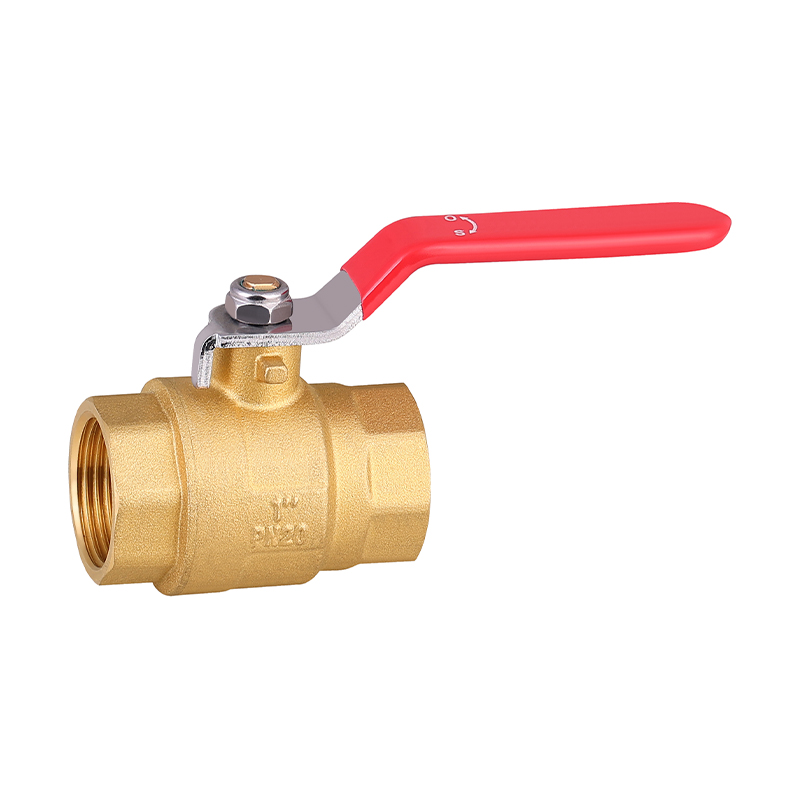 GH1002 Brass Full-Port Threaded Ball Valve, Female x FemaleA full-port brass ball valve for isolating distribution lines with minimal added resistance; forged body, 2.5 MPa rating, and sizes from 1/2 to 2 inches.View Product →
Segmenting a System: The Purpose Buyers Underestimate
The most valuable purpose of a small brass valve is not sealing - it is limiting the consequences of a failure. A building without sectionalizing valves forces every repair, every drain-down and every tenant complaint to be handled at the level of the whole riser or the whole building.
The economics are easy to sketch. A half-inch brass ball valve costs a few dollars and ten minutes of labour during construction. A single uncontrolled leak that requires an unplanned shutdown of a riser in a fifty-unit building can cost thousands in emergency labour, water damage remediation and lost revenue, plus the reputational damage of an afternoon without water. That gap is why good specifications call for isolation at defined boundaries:
- At every riser take-off and every floor branch.
- Upstream and downstream of every pump, boiler, water heater, tank and coil.
- At every water meter and every sub-meter.
- At every fixture group, laboratory bench, kitchen and janitorial sink.
- At every irrigation zone valve box and every external hose connection.
- At every low point intended for draining and every high point intended for venting.
Two design details make those valves actually usable later. First, put them where a person can reach them without cutting a ceiling, because a valve behind drywall is a valve that will be opened with a saw. Second, label them with the zone they control; a labelled valve turns a two-hour search into a twenty-second operation.
Control, Locking and Tamper Resistance as a Purpose
In some applications, the purpose of the valve is not only to stop flow but to keep it stopped. Brass ball valves are made with locking features that serve four distinct needs:
- Lockout and tagout. A handle with a padlock hole lets maintenance staff lock a line in the closed position during work, which is a safety requirement in most industrial environments and good practice everywhere.
- Revenue protection. Magnetic-locking and key-operated valves prevent a customer or contractor from reopening a supply that the utility has shut off.
- Theft prevention. Anti-theft meter valves with a magnetic or coded key stop unauthorized tapping of a shared supply in apartment blocks, marinas and irrigation networks.
- Operational discipline. Locked-open or locked-closed positions remove the temptation for well-meaning staff to change a setting that was engineered deliberately.
The engineering detail that separates a good locking valve from a poor one is the actuator interface. A cheap locking device is a plastic or soft-alloy collar that shears the first time someone leans on a wrench. Better designs key the locking mechanism into the stem or the handle boss so the torque path stays inside metal.
Water-meter isolation is the classic case: the valve must close reliably against full mains pressure, remain closed without maintenance for years, and refuse to be reopened by anyone without the correct key. Models such as GH1028, a magnetic-lockable brass ball valve designed specifically for water-meter duty, exist because that combination of requirements is different from ordinary domestic isolation.
 GH1028 Magnetic-Lockable Brass Ball Valve for Water Meter IsolationDesigned for water-meter duty, this full-port brass valve uses a proprietary magnetic key to limit unauthorized operation and supports reliable isolation under mains pressure.View Product →
Material Choice Is Part of the Purpose
The body alloy decides which purposes the valve can serve. Three families dominate the market.
Forged brass. The default for small valves from 1/4 inch to about 2 inches. It machines quickly, holds fine threads, and costs less than bronze. Standard leaded forging brass is not dezincification-resistant, so it belongs in neutral, treated water where the chloride content and temperature are controlled. In aggressive or high-chloride water, a dezincification-resistant grade or bronze should be used instead.
Bronze. Cast bronze bodies are stronger in larger sizes, resist dezincification by nature, and tolerate seawater and brackish water far better than brass. They cost more and are heavier, which is why they appear in marine, irrigation and industrial water service rather than in bathroom cabinets.
Stainless steel. Chosen for chemical compatibility, hygiene and higher temperature, at a significant cost premium. It is a different specification rather than an upgrade, since stainless threads gall more easily and the body requires different sealing practice.
Surface treatment also serves a purpose. Nickel plating on a brass ball valve does three things: it protects the external surface in humid, coastal or wash-down environments, it improves appearance in visible installations, and it reduces the risk of surface corrosion products staining surrounding materials. It is not a substitute for a dezincification-resistant alloy, because plating protects the outside of the body rather than the alloy structure itself. Nickel-plated full-port models such as GH1003 are commonly chosen for visible plant rooms and humid coastal projects where appearance and external corrosion both matter.
 GH1003 Nickel-Plated Brass Full-Port Ball Valve for Humid InstallationsNickel plating protects the external brass body in humid or coastal settings, while the full-port design provides quick on/off control for water, air, or gas.View Product →
Inside the valve, the seat and seal materials define the working envelope. Virgin PTFE seats handle the widest range of water and steam service up to roughly 200 degrees Celsius with pressure derating. Reinforced PTFE resists extrusion better at higher pressures. Nitrile or Viton seals are used in gas and fuel service, while EPDM appears in potable water and steam applications where its temperature and chemical profile fits.
Potable water adds a legal dimension. In the United States, valves in contact with drinking water must meet the lead-free requirements of NSF/ANSI 372 and the health-effects requirements of NSF/ANSI 61, with a weighted average lead content at or below 0.25 percent. In Europe, EN 13828 covers manually operated copper-alloy ball valves for potable water in buildings, and national schemes such as WRAS, KIWA, ACS and DVGW add their own material and leaching tests. A valve without the right approval for its market is not a cheaper valve; it is a liability that can fail inspection and force replacement of an entire installed batch.
Temperature, Pressure and the Numbers Behind the Purpose
Brass ball valves are commonly marked with two ratings: WOG (water, oil, gas) and WSP (working steam pressure). A typical small valve might carry 600 WOG and 150 WSP. Those numbers are not valid across the whole temperature range, because the limiting component is usually the polymer seat, not the brass body. As temperature rises, PTFE softens and creeps, so the allowable pressure falls.
| Media temperature | Indicative maximum pressure | Practical note |
|---|---|---|
| Up to 38 C (100 F) | 41 bar / 600 psi | Full WOG rating applies |
| 65 C (150 F) | 38 bar / 550 psi | Domestic hot water service |
| 93 C (200 F) | 34 bar / 500 psi | Heating and radiant loops |
| 121 C (250 F) | 28 bar / 400 psi | Low-pressure steam begins here |
| 149 C (300 F) | 21 bar / 300 psi | Steam service normally limited well below this |
| 177 C (350 F) | 14 bar / 200 psi | Seat creep accelerates; cycling should be infrequent |
| 204 C (400 F) | 10 bar / 150 psi | Practical ceiling for standard PTFE seats |
Three practical consequences follow. First, sizing must consider surge, not just static pressure; water hammer from a fast-closing quarter-turn valve can briefly double the line pressure, which is why the valve is often closed slowly by hand even though it can be snapped shut. Second, freezing water inside the ball cavity will crack a brass body, since the trapped volume has nowhere to expand; drain-down valves and insulation are not optional in cold climates. Third, steam above roughly 10 bar should not be entrusted to a standard brass ball valve with polymer seats, regardless of what the body rating says.
Purpose by Application
The same product category serves very different duties depending on where it is installed. The following table summarizes how the purpose shifts from segment to segment.
| Application | Primary purpose | Typical configuration |
|---|---|---|
| Domestic water risers and zones | Sectionalizing and repair isolation | 1/2 to 2 inch, full port, female x female, lever handle |
| Water meters | Custody control and tamper resistance | Lockable or magnetic-locking, often with a swivel adapter |
| Water heaters and boilers | Isolation and drain-down | Full port plus a boiler drain at the low point |
| HVAC fan coils and terminals | Coil isolation for service | Full port, sometimes combined with a strainer or balancing valve |
| Compressed air drops | Rapid isolation and lockout | Reduced or full port, lockable handle, dry-air compatible seats |
| Gas and LPG lines | Positive shutoff with anti-static protection | Gas-approved body and seats, quarter-turn with limited travel stop |
| Irrigation zones | Zone control and winterization drain | Reduced port with slip or threaded ends, plus drain capability |
| Marine and bilge service | Corrosion-resistant isolation | Bronze body, dezincification-resistant trim |
Notice that the purpose rarely changes in kind - it is always isolation - but the consequences of failure change completely. A leaking valve on an irrigation line costs water. A leaking valve above a server room costs equipment. That difference, not the valve itself, should drive the specification.
Combined-Purpose Valves: Filtration, Drainage and Direction Change
Manufacturers build several hybrid bodies that let one fitting do two jobs. Each one exists because an installer needed both functions at the same point in the line.
- Y-type filter ball valve. A strainer screen sits in the flow path beside the ball, so the valve isolates and protects downstream equipment in one body. This is common at meter outlets and ahead of solenoid valves and flow meters.
- Angle ball valve with swivel. The 90-degree outlet removes an elbow and allows the supply to be aligned to a fixture without extra fittings.
- Boiler drain and drain cock. The purpose is emptying, not isolation; the body is designed for hose connection and low-cost replacement.
- Temperature-measuring ball valve. A probe port in the body allows a thermometer or sensor to be inserted in the flow without a separate tapping.
- Press, compression and PEX-ended valves. The purpose is to join directly to plastic or thin-wall tubing, removing the need for adapters and reducing potential leak points.
Combination valves save material and labour, but they concentrate risk: if the strainer clogs or the probe port weeps, the whole valve must be replaced. On critical lines, many specifiers still prefer separate components that can be serviced independently.
Actuation: When the Purpose Expands to Automation
A quarter-turn valve is the easiest valve type to automate, and that is one of its most valuable characteristics. With an electric or pneumatic actuator on an ISO 5211 pad, the same brass body can become a remote isolation point that responds to a building management system, a leak detection cable, a pressure switch or a timed schedule.
Three engineering points matter more than the actuator brand:
- Torque margin. Size the actuator at 1.5 to 2 times the published breakaway torque of a new valve, then add margin for aged seats and deposits. Undersized actuators stall silently and are discovered only when isolation is needed.
- Fail position. Decide in advance whether the valve should fail open, fail closed, or stay put on power loss. On domestic water, fail closed is usual; on heating and cooling circuits, fail open is often safer.
- Cycle expectation. A valve actuated hourly has a very different wear profile from one cycled twice a year. For high-cycle duty, specify reinforced seats, a properly supported stem and a body with a documented cycle rating.
The purpose also expands here in a way that is easy to overlook: an automated valve converts a manual maintenance task into a control function, which means the specification now has to satisfy two disciplines. A valve that isolates perfectly can still fail as a control element if the actuator is oversized for the line, hammering the system on every closure. Slow-closing or characterized actuators are used in those cases.
Standards, Testing and the Paperwork That Proves the Purpose
The purpose of a valve is only met when the product is verifiably built to it, and that is where standards and test records come in. The documents a competent buyer should expect include:
- A design standard reference, such as MSS SP-110 for threaded and grooved ball valves, ASME B16.34 for valve pressure-temperature design, API 608 for industrial metal ball valves, or EN 13828 for building ball valves in potable water.
- A thread specification: ISO 228-1 parallel threads, NPT to ANSI B1.20.1, or BSPT taper threads for sealing by thread interference. Mismatched thread forms are among the most common causes of leaks on site.
- Pressure test results, normally a shell test at 1.5 times rated pressure and a seat test at 1.1 times rated pressure, with leakage acceptance per ISO 5208 or API 598.
- Material certificates for body, ball, stem and seats, plus RoHS and REACH declarations where applicable.
- Potable-water approvals for the destination market, and gas approvals where the line carries fuel gas.
Testing is not a formality; it is where thin castings, porous plating and badly machined seats are caught. A reputable factory pressure-tests every valve above its working pressure to confirm the sealing structure, the strength design and the functional requirement before the valve is packed. Buyers who want to understand how manufacturing choices affect the finished product often find it useful to review the ball valve manufacturing process and material selection in detail, because the sequence from brass rod to packed valve determines most of the failure modes described in the next section.
The production sequence itself is worth knowing when you audit a supplier. It starts with cutting brass rod to length, then forging or casting the body and the ball blank, then precision machining of threads, bore and stem bore, then plating of the ball and often the body, then assembly of seats, stem and handle, then pressure testing, then packaging. A factory with a large installed base of production and test equipment, in the range of 120 machines or more, has the capacity to control those steps internally rather than buying finished valves for resale, which is a meaningful difference when you need consistent quality across repeat orders.
Procurement Risks: Ten Ways a Brass Ball Valve Fails Its Purpose
Most ball valve failures in service trace back to a purchasing decision rather than an installation mistake. The following risks appear repeatedly in incoming inspection.
- Reduced port sold as full port. The single most common substitution. Verify bore diameter, not catalogue wording.
- Under-thickness walls. Cheaper castings are thinner, which lowers burst margin and makes thread engagement fragile.
- Ball or stem material substitution. An unplated or thinly plated ball corrodes and tears seats; a weakened stem shears under a stuck-handle load.
- Lead content above the limit. A valve without valid potable-water approval cannot legally be installed and may have to be removed after inspection.
- Thread form mismatch. Parallel and taper threads, or metric and imperial pitches, sealed with the wrong tape or paste, will leak regardless of valve quality.
- Torque creep and handle failure. Soft handles deform before the stem does, then cannot be gripped with a wrench.
- Seat material substitution. Recycled or low-grade PTFE deforms at lower temperature and extrudes into the bore under pressure.
- No blowout-proof stem. On valves without a retained stem, pressure can eject the stem if the gland nut is disturbed.
- Plating porosity. Thin or porous nickel plating on a coastal project corrodes from underneath and looks new until it suddenly does not.
- Documentation that does not match the shipment. Certificates for one batch attached to valves from another are worse than none, because they hide the risk.
A practical incoming inspection routine is short and inexpensive: measure the bore at both ends, check the thread with a go/no-go gauge, weigh the valve against the reference sample, rotate the handle and record breakaway torque with a small torque wrench, and cut open one valve per batch to inspect wall thickness and seat material. These checks take minutes and catch most of the problems above before installation.
When a Brass Ball Valve Is the Wrong Choice
Knowing the limits of the product is as useful as knowing its purpose. Avoid a standard brass ball valve in these situations:
- Continuous throttling. Use a globe, needle or balancing valve instead.
- High-temperature steam. Above roughly 150 to 180 degrees Celsius, and above about 10 bar of steam, polymer seats are the weak link.
- Large diameters. Above two inches, the cost and the operating torque rise sharply, and a butterfly or gate valve becomes more economical.
- Abrasive or fibrous media. Slurries and fibrous waste score seats and pack around the ball.
- Aggressive, high-chloride water. Use dezincification-resistant brass or bronze, or the body will fail from the inside out.
- Buried service without protection. Soil corrosion and mechanical loading need wrapped or sleeved assemblies and accessible boxes.
- Hygienic and pharmaceutical service. Those systems require stainless bodies and documented surface finishes.
- Oxygen service. Requires specially cleaned, non-oil-contaminated valves; standard brass units are not acceptable.
- Very high cycle control duty. Thousands of actuations per day demand industrial-grade bodies with documented cycle life.
In each case the purpose is still isolation or control, but the product class changes. Specifying a brass ball valve anyway is how projects end up replacing hundreds of valves three years after handover.
Specification Checklist for Buyers and Specifiers
Use the following list as a short pre-purchase review. Every line should have a written answer before a purchase order is issued.
- Function: isolation only, or isolation with a second duty such as filtration or drainage?
- Port type: full port, reduced port or mini, with the required Cv confirmed.
- Size and end connections: nominal size, thread standard, press, compression or PEX, and whether a swivel is needed.
- Body material and corrosion requirement: standard brass, dezincification-resistant brass, bronze or stainless.
- Potable-water or gas approval valid for the destination market.
- Pressure rating at the actual operating temperature, not at ambient.
- Temperature range with the specified seat material.
- Media compatibility of ball, stem, seats and seals.
- Operating mode: manual lever, butterfly handle, locking handle, actuator ready.
- Safety features required: blowout-proof stem, anti-static device, lockable or magnetic locking.
- Cycle expectation and maintenance interval.
- Testing documentation: shell and seat test results, leakage class, batch traceability.
- Finish: bare brass, nickel plated, plating thickness specification.
- Packing and labelling requirements for storage and site distribution.
If a supplier cannot answer most of those questions in writing, the valve is being sold as a commodity, and commodity valves are the ones that quietly stop working.
The purpose of a brass ball valve is to be the most reliable, cheapest and least disruptive way to stop the flow in a small line when you need to. It does that job by giving you a quarter-turn, bubble-tight, low-resistance closure that survives long idle periods and can be automated cheaply when the system grows. It does not regulate flow, it does not belong on high-temperature steam, and it cannot compensate for a body alloy that is wrong for the water it carries.
That is why the decision is rarely "which valve is cheapest" and almost always "what exactly must this valve do, for how many years, at what temperature, in what water, and who will have to operate it at three in the morning". Answer those five questions and the specification writes itself: the port type, the alloy, the seat material, the approval and the locking feature all fall out of the answers. A valve chosen that way will do its job for the life of the building, and the plumber in the opening story will find the right handle on the first try.