Español
 عربى
 Deutsch
 русский
 Français

A maintenance technician calls about a half-inch brass fitting that has been weeping at the joint for three weeks. The fitting is not the problem. In most cases like this, an NPT thread has been screwed into a parallel G port, or a compression nut has been tightened until the olive crushed the copper tube. The hardware was sound; the interface was wrong. That is why the question of which brass fitting types are most common only becomes useful once you also know how each type seals, what tube or pipe it expects, and how it fails.
The direct answer: the three most common types of brass fittings are threaded (screw) fittings, compression fittings, and push-to-connect fittings. Those three account for the overwhelming majority of brass fittings sold into plumbing, heating, water metering, pneumatic, and light industrial work. Flare fittings, barbed hose fittings, and press fittings form the next tier, and each of them owns a specific niche such as gas appliances, refrigeration, irrigation, PEX systems, or instrument air.
Everything below follows that order of usefulness: first the answer, then the reason each type behaves the way it does, then the sizing, alloy, pressure, and installation details that decide whether a joint survives ten years of thermal cycling or fails after the first hot-water season.
The Short Answer, and Why the Count Depends on How You Read the Question
If you count by connection method, the answer is threaded, compression, and push-to-connect. If you count by shape, the answer you will find in most distributor catalogues is couplings, elbows, and tees. Both answers are correct in their own context, and buyers who confuse the two end up ordering the right shape with the wrong connection. A half-inch brass tee is not a complete description of a part; a half-inch NPT brass tee is.
The three connection types are distinct because each one seals in a fundamentally different way. Threaded fittings seal through interference between mating threads plus a sealant that fills the spiral gap. Compression fittings seal by permanently deforming a brass olive onto the outside diameter of a tube. Push-to-connect fittings seal with an elastomer O-ring compressed against the tube wall, while a stainless grab ring holds the tube in place. Those three mechanisms behave differently under pressure, temperature, vibration, and reassembly, and they fail in different ways.
| Type | How it seals | Typical size range | Typical working pressure | Where it is used | Most common failure |
|---|---|---|---|---|---|
| Threaded (NPT, BSPT, BSPP) | Tapered thread interference; sealant fills the helical gap. Parallel threads need a gasket or bonded washer. | 1/8 in. to 4 in. nominal pipe size | 150 to 200 psi WOG for plumbing grades; higher for instrumentation grades | Water service, meter sets, valve connections, HVAC, indoor gas piping | Cross-threading, NPT mated to BSP, cracked brass female ports |
| Compression | A nut drives a brass olive onto the tube outside diameter, creating a line contact seal. | 4 mm to 54 mm, or 3/16 in. to 2 in. tube OD | Around 10 bar (145 psi) is common; some designs reach 16 bar | Copper and plastic supply lines, fixture connections, boiler trim, heating | Over-tightening, missing insert on plastic tube, wrong tube outside diameter |
| Push-to-connect | An EPDM O-ring seals against the tube wall; a stainless grab ring resists pull-out. | 1/4 in. to 1 in. tube OD and metric equivalents | About 200 psi at 23 degrees C, falling sharply as temperature rises | Retrofit repairs, manifolds, appliance connections, PEX and copper | Scored tube, ignored temperature derating, tube pushed past the depth mark |
Read the table as a decision aid rather than a ranking. A threaded fitting is not better than a compression fitting; it is better for a different pipe end. The mistake that costs the most money in the field is choosing by habit, then discovering that the connection does not match the surface it has to seal against.
One more point that rarely appears in short answers: the "three most common" list stays stable because these three methods cover the three practical ways to join a rigid pipe, a soft tube, and an existing line that cannot be taken out of service. Threaded fittings handle rigid pipe, compression fittings handle small-bore tube with a wrench, and push-to-connect fittings handle a live repair with no flame and no press tool.
Threaded Brass Fittings: The Oldest and Still the Most Common
Threaded brass fittings dominate because pipe threads are standardized, tooling is simple, and a threaded joint can be broken and remade with a wrench. The two families that matter are NPT, defined in ASME B1.20.1 with a 60 degree thread angle and a 1 in 16 taper, and the BSP family, where BSPT (ISO 7-1) is tapered and BSPP (ISO 228-1, often marked G) is parallel. Threaded fittings seal because the tapered threads interfere along their flanks as they are driven together, and the sealant occupies the remaining helical path between the crests and roots.
Why NPT and BSP Are Not Interchangeable
This is the single most expensive misunderstanding in brass fitting procurement. A 1/2 in. NPT male and a G1/2 male both carry 14 threads per inch, so they will start to engage by hand and feel plausible for two or three turns. The flank angles differ, 60 degrees against 55 degrees, and the taper is present on one and absent on the other. The result is partial engagement, a joint that cannot be tightened further without damage, and a slow weep that appears only under pressure or after thermal movement. If a specification sheet says "half inch thread," it has not specified anything. It must say NPT, BSPT, or BSPP, and the drawing should carry the standard number.
Sizes, Engagement, and Torque
Nominal pipe size is a reference dimension, not a measurement. A 1/2 in. NPS pipe has an outside diameter of 21.3 mm (0.840 in.) and an inside diameter near 15.8 mm in schedule 40 wall. Nothing on the fitting measures half an inch. On assembly, four to six full threads of engagement is the usual target, with two or three threads still visible on a taper joint. For brass, the risk is asymmetric: brass male threads into a brass or bronze female port can be tightened firmly, but a steel or stainless male thread driven hard into a brass female port will split the port, because the brass deforms before the steel does. Once a brass port has been cracked, no amount of sealant will recover it.
Sealants and Common Forms
PTFE tape applied in the direction of the thread helix, two or three wraps with the first thread left clean, works for water and most non-critical services. Anaerobic thread sealants are the better choice for gas, for high-vibration equipment, and for stainless threads that gall. Sealant belongs on male threads only, and it never belongs on a flare seat, an O-ring face, or a compression olive.
The threaded family is broad: hex nipples, couplings, unions, reducing bushes, caps, plugs, 90 degree and 45 degree elbows, equal and reducing tees, street elbows, hose adapters, water meter swivels, boiler drains, and the threaded bodies of ball valves, gate valves, check valves, and strainers. A single distributor shelf can hold four hundred threaded SKUs and still be missing the one reducing bushing a job needs.
 GH-6006 Brass Threaded Tee Fitting for Piping SystemsView this brass tee where threaded branch connections are needed for water, HVAC, or compressed air systems requiring up to 16 bar.View Product →
Where threaded fittings win: water service entrances, meter sets, valve-to-pipe connections, HVAC headers, equipment isolation, and any location where the joint must be disassembled for maintenance. Where they lose: thin-wall tube, plastic pipe, and any installation where the installer cannot guarantee clean, undamaged, correctly identified threads.
Compression Brass Fittings: The Default for Copper and Small-Bore Tube
A compression fitting has three working parts: a body with a machined seat, a nut, and an olive or ferrule. When the nut is tightened, it pulls the olive forward and compresses it radially onto the tube outside diameter. The seal is a narrow band of contact, which is why surface condition of the tube matters more than almost anything else in this family. A scratch, a burr, or a compression ring left by a previous olive will produce a weep that survives every attempt at re-tightening.
Sizing: Tube Outside Diameter, Not Pipe Size
Compression fittings are sized by tube outside diameter, and this is where metric and imperial systems collide. In the United Kingdom and much of Europe, 15 mm and 22 mm copper are the standard domestic sizes. In North America, 1/2 in. and 3/4 in. nominal copper tubing have outside diameters of 5/8 in. and 7/8 in., and the fittings are catalogued by that outside diameter. Imperial half-inch copper has an outside diameter of 12.7 mm, which is not 15 mm, so a 15 mm olive will never compress correctly onto it. The joint may hold at 2 bar on a test gauge and weep at 6 bar two weeks later.
Pressure, Temperature, and Plastic Tube
Metal-to-metal compression joints on copper are commonly rated around 10 bar (145 psi), with some dezincification-resistant designs reaching 16 bar. Temperature capability depends on the tube and any plastic components in the assembly; a compression joint on copper can serve hot water well, while a compression joint on PEX requires a support sleeve or insert inside the tube to prevent the tube wall from creeping out from under the olive. Omitting that insert is a frequent and invisible error, because the joint may pass an initial pressure test and then relax over months.
Reuse and Failure Modes
The nut and body are reusable, the olive is not, at least not on any joint that matters. When re-making a compression joint, cut the tube back so the new olive seats on fresh, round material. Two wrenches are mandatory: one on the body to hold it against rotation, one on the nut. A single wrench twists the whole assembly and can loosen the far end of the fitting.
The characteristic failures are predictable. Over-tightening crushes the olive and necks the tube, which reduces the wall thickness at exactly the point of highest stress. Under-tightening produces a joint that weeps only when the system reaches temperature. Cross-threading the nut, usually caused by starting it at an angle in a tight space, damages the threads and the olive seat simultaneously. Vibration loosens the nut over time, which is why compression fittings should be supported and, on equipment, checked at service intervals.
 GH-6017 Brass Compression Equal Tee for PEX and CopperConsider this compression equal tee for accessible branch connections in potable water, hydronic heating, or HVAC lines using PEX, copper, or composite pipe.View Product →
Code limits matter here. Many jurisdictions restrict or prohibit concealed compression fittings inside walls and floors without access, on the grounds that the joint depends on a mechanical deformation that cannot be inspected later. That restriction is not a comment on quality; it is a recognition that compression joints are serviceable, not permanent.
Push-to-Connect Brass Fittings: Fast, Forgiving, and Easy to Misuse
Push-to-connect fittings, also called push-fit or quick-connect, use a collet with stainless steel teeth, a grab ring, and an elastomer O-ring inside a brass or DZR body. The tube is pushed in until it passes the O-ring and the grab ring bites into the surface. The O-ring does the sealing; the teeth do the retaining. This is why the surface finish of the tube is the single biggest determinant of success, and why the failure of a push fitting is almost always an installation failure rather than a manufacturing one.
Installation Discipline
Cut the tube square with a roller cutter, deburr the inside and outside, and mark the insertion depth with a pencil or the gauge supplied with the fitting. Push until the mark disappears, then tug firmly to confirm the grab ring has engaged. The tug test is not optional; it is the only field verification available before pressure is applied. Removal requires a release clip or a demounting tool, and the fitting is generally reusable. The tube end is not reusable if the teeth have scored it. Cut back past the score marks before reinserting.
Pressure, Temperature, and Water Chemistry
The headline rating on most push-to-connect brass fittings is in the region of 200 psi at 23 degrees C. That number falls quickly with temperature. By the time a system reaches 80 to 90 degrees C, the allowable pressure can be less than half of the cold rating, and each manufacturer publishes its own derating curve. Reading only the largest number on the label is a common source of premature failure on heating systems and recirculating hot water loops. The fitting is not failing because it is poorly made; it is being used outside the envelope it was certified for.
Water chemistry matters as much as temperature. Free chlorine and chloramine attack elastomers over time, and the O-ring compound has to be matched to the service. EPDM is the usual choice for potable water and heating. Bodies intended for potable water in aggressive areas are frequently made from dezincification-resistant brass, which resists the loss of zinc that turns ordinary brass porous and weak in high-chloride, low-pH water.
Approval Boundaries
Most push-to-connect brass fittings are approved for water and heating only. Gas approval, where it exists, is product-specific and jurisdiction-specific, and the approval belongs to the exact model and size rather than to the category. The same caution applies to compressed air and to any application involving hydrocarbons, where the elastomer may swell or degrade. Check the marking on the fitting and the listing document, not the catalogue photograph.
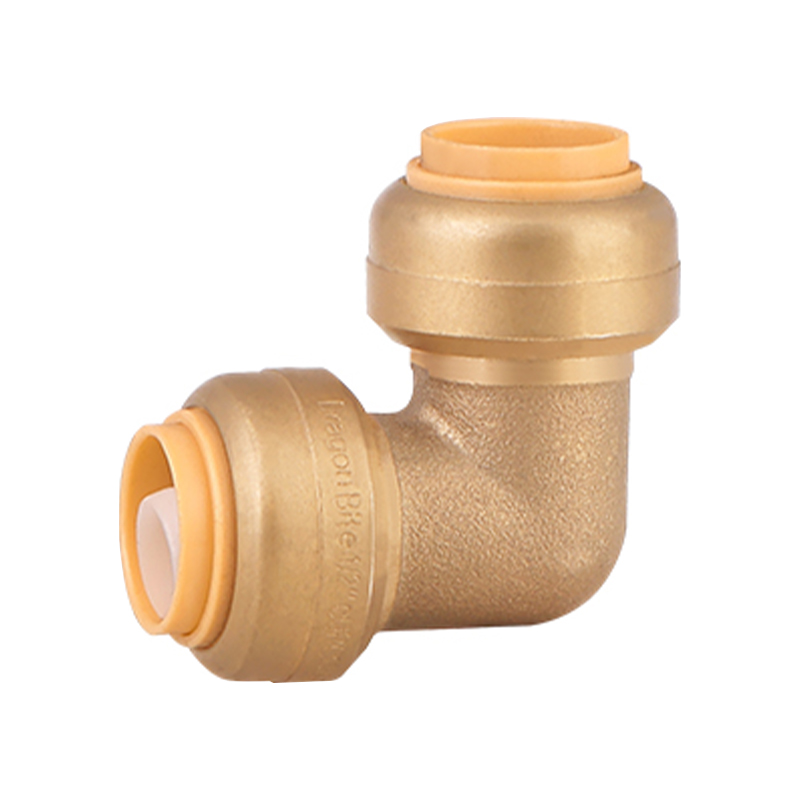 GH-6015 Push-Fit Brass Fittings for PEX PlumbingReview these push-fit brass fittings for fast, accessible PEX plumbing connections; compatibility spans copper, CPVC, PEX, PPR, and PEX-al-PEX in water and heating applications.View Product →
The practical value of this type is speed and access: a repair behind a finished wall, a manifold installation with dozens of connections, or a retrofit where draining the system is not acceptable. The practical risk is that speed encourages shortcuts, and shortcuts are exactly what this design cannot tolerate.
Beyond the Top Three: Flare, Barbed, Press, and Sweat
The three main types answer the common question, but four other families show up often enough in procurement conversations to deserve a short comparison.
Flare Fittings
A flare fitting seals when a cone presses a flared tube end against a matching seat. The two common geometries are SAE 45 degree, used in plumbing and gas appliance connections, and JIC 37 degree, used in hydraulics. The tube must be annealed and cut square, and the flare must be formed with the correct tool; an over-flared or cracked cone leaks no matter how much torque is applied. No sealant goes on the seat. Flare connections are preferred where a joint must be opened repeatedly and where a soft metal seal is more reliable than a thread sealant, such as gas ranges, dryers, and refrigeration lines.
Barbed Hose Fittings
A barbed fitting is pushed into a flexible hose and secured with a worm-drive, spring, or crimp clamp. Sealing depends on hose elasticity, so barbs are sized by hose inside diameter, not pipe size. Pressure capability is modest and falls with temperature and with hose hardness. These fittings belong in irrigation, drainage, low-pressure pneumatics, and wash-down lines. A 1/2 in. barb will not fit 1/2 in. tube, and forcing it damages the hose wall and creates a leak path that no clamp can close.
Press and Crimp Fittings
Press fittings are swaged onto copper or PEX tube with a calibrated tool and the correct jaw profile. In North America, copper press fittings are covered by ASME B16.51 and PEX insert systems by standards such as ASTM F1807 and F1960, depending on the connection style. The advantages are speed and repeatability, since the seal is created by a machine rather than by feel. The corresponding risk is that an unpressed fitting can hold at low test pressure and fail later, which is why tool calibration records, jaw inspection, and a visual verification pass matter more than the pressure gauge.
Sweat and Solder Fittings
Sweat fittings use a capillary gap and a filler metal rather than a mechanical seal. They are as permanent as the tube itself and remain the benchmark for concealed work in copper systems, but they require a torch, and the heat will destroy any push-to-connect fitting or O-ring within a few hundred millimetres. Assemblies that mix press, push, and solder should be built on the bench, not in place.
The Other Reading: Couplings, Elbows, and Tees
Many people who search for the three most common types of brass fittings are really asking about shape, because that is what they see on a shelf. If the question is answered that way, the three most common shapes are couplings (straight connectors), elbows, and tees. This is a useful framing for stock planning, since the three shapes times the three connection methods times a dozen sizes times several alloys produces the thousands of line items that fill a fittings catalogue.
- Couplings and straight connectors join two lengths of tube or pipe in a straight run, and may be equal or reducing.
- Elbows change direction, in 90 degree or 45 degree form, with street elbows combining a fitting end and a spigot end in one part.
- Tees create a branch, in equal or reducing configurations, and crosses perform the same function with two branches.
- Adapters and reducers translate between connection systems, such as male thread to compression, thread to push-fit, or metric to imperial.
- Caps, plugs, and unions close a line or provide a serviceable break point, and unions are essential where equipment will be removed for maintenance.
- Specialty bodies combine a function with a connection, including Y-strainer bodies, water meter swivel adapters, stop valves, and boiler drains.
The reason this distinction matters commercially is that brass pipe fittings are usually specified by function and connection together. A stock list organized by connection type first, then shape, then size, prevents the most common ordering error in the trade: a correct part in the wrong connection system, returned at the buyer's cost.
Alloys, Lead Limits, and Dezincification: What the Brass Actually Is
Two fittings can look identical, carry the same nominal size, and behave completely differently in service because the alloy is different. For potable water and for aggressive water chemistry, the alloy is not a detail. It is the specification.
| Alloy | Composition highlights | Typical use | Cautions |
|---|---|---|---|
| C36000 free-cutting brass | Copper about 61.5 percent, zinc about 35.5 percent, lead about 3 percent | Machined parts, small fittings, nipples, hex stock | High lead content; generally unsuitable for potable water wetted surfaces |
| C37700 forging brass | Copper about 59 percent, zinc about 39 percent, lead about 2 percent | Forged valve bodies and fittings | Verify lead compliance for drinking water service |
| C46400 naval brass | Copper about 60 percent, zinc about 39 percent, tin about 0.75 percent | Marine and seawater-adjacent fittings | Higher cost; specify only where corrosion demands it |
| DZR brass, such as CW602N or C35330 | Copper-zinc brass with controlled arsenic or antimony addition | Potable water fittings, push-to-connect bodies, aggressive water areas | Confirm the dezincification test result rather than the marketing claim |
| Lead-free bismuth or silicon brasses | Bismuth or silicon replacing lead for machinability | Potable water fittings in regulated markets | Different machining behavior; consistency between lots must be verified |
Lead and Drinking Water Rules
In the United States, fittings intended for potable water are typically evaluated under NSF/ANSI/CAN 61 for health effects and NSF/ANSI 372 for lead content, where the weighted average lead across wetted surfaces must not exceed 0.25 percent. Europe and several other regions have been moving in the same direction under drinking water directives and national approval schemes, with tightening limits on lead and other metals leaching into drinking water. For a buyer, the practical conclusion is simple: an alloy certificate and a third-party listing number are worth more than any statement about "high quality brass" in a catalogue.
Dezincification
Dezincification is the selective removal of zinc from brass, leaving a porous copper residue that looks intact but has almost no strength. It is driven by water chemistry, particularly elevated chloride, low pH, and higher temperature, and it appears in stagnant or slowly moving water such as dead legs and closed valves. Dezincification-resistant brasses are tested under ISO 6509, and a commonly used acceptance criterion is a maximum dezincification depth of 100 micrometres. When a specification calls for DZR, it should also require the test report, because the alloy designation alone does not prove the heat treatment and the test result.
Pressure and Temperature: Why One Number Is Never Enough
A fitting rated at 200 psi is not rated at 200 psi in every condition. Ratings are stated for a reference temperature, often 23 degrees C (73 degrees F), and they fall as temperature rises. The reduction is not linear and it is not small. A push-to-connect joint that holds 200 psi cold may be limited to less than half of that at 85 degrees C, and a compression joint on plastic tube can lose capability earlier than the same joint on copper. Always match the rating to the actual service condition, including the hottest expected temperature and the highest sustained pressure, not the nominal system pressure.
Water hammer is the other reason single numbers mislead. A fast-closing valve can produce transient pressure spikes several times the static pressure in the line, and those spikes load the fitting far beyond the steady-state condition. Arrestors, slow-closing valves, and proper pipe support reduce the exposure. Freezing is a separate risk with the same outcome, since expanding ice will split a brass fitting or body long before it splits the pipe, especially in dead legs running through unheated spaces.
On the manufacturing side, hydrostatic testing is normally performed at a pressure above the working rating, and the useful questions for a supplier are how much above, for how long, and whether the test is applied to every unit or to a sample batch. A 100 percent leak test on assembled valve and fitting products is a different level of assurance than a sampled pressure check, and the difference should be reflected in the specification rather than assumed.
Sizing and Thread Compatibility: Where Most Leaks Begin
Three sizing systems appear in the same catalogue page and are routinely confused. Nominal pipe size describes pipe and threaded fittings and does not correspond to any single measured dimension. Tube outside diameter describes compression and push-to-connect fittings and corresponds to a real measurement. Metric and imperial versions of both systems differ by millimetres that matter.
A 15 mm compression fitting will not seal on 1/2 in. imperial copper with a 12.7 mm outside diameter. A 22 mm fitting will not seal on 3/4 in. copper at 19.05 mm. PEX adds its own layer of complexity, with metric sizes such as 16, 20, and 25 mm alongside imperial 1/2 in. and 3/4 in., plus dimension differences between PEX-A and PEX-B systems that determine which insert or sleeve is correct. The insert must match the tube system, not just the nominal size.
Thread systems carry the same trap. NPT is standard in North America; BSPT and BSPP dominate in the United Kingdom, Europe, the Middle East, and much of Asia. A 1/2 in. NPT male and a G1/2 male share a thread count of 14 per inch but differ in flank angle and taper, so they engage partially and leak. Any purchase order that specifies a thread without naming the standard is incomplete, and the cost of that omission is usually discovered on site, at the far end of a shipping container.
Installation Practices That Decide Whether a Joint Lasts
The three most common brass fitting types fail for different reasons, but a short list of practices covers most of the risk in all of them.
- Cut tube square with a roller cutter where possible, and deburr inside and outside. A hacksaw cut leaves a burr that damages O-rings and prevents a compression olive from seating squarely.
- Use two wrenches on compression and threaded joints. One holds the body against rotation; the other tightens the nut or the mating part.
- Mark insertion depth on every push-to-connect joint and perform a tug test before the system is filled.
- Apply thread sealant to male threads only, leaving the first thread clean. Never apply sealant to a flare seat, an O-ring face, or a compression olive.
- Replace olives on any joint that matters rather than reusing a deformed one, and cut the tube back to undamaged material.
- Support the pipe so the fitting does not carry bending load, and follow the support spacing required by the applicable code for the tube or pipe material.
- Isolate dissimilar metals. Brass connected directly to stainless steel or aluminum in a wet environment creates a galvanic couple; a dielectric union or insulating sleeve breaks the path. Brass to copper is generally acceptable.
- Pressure test at a level above the working pressure, hold it long enough to observe a slow weep, and re-check after the system has been through a thermal cycle.
- Keep heat away from elastomer-containing fittings. Solder or braze assemblies on the bench, then install the push and press components.
- Give installers a small torque table for the sizes actually used on site. Feel is not a specification, and in a training environment it produces inconsistent results.
Where Each Type Earns Its Place
Water metering and service connections are threaded territory, often with dezincification-resistant bodies and lockable or magnetic-lock features to prevent tampering. Meter swivel adapters and meter check valves exist precisely because the thread standard, the sealing face, and the tamper protection all have to be agreed before the part is made.
Domestic water distribution is a mix. Compression fittings on copper remain common in renovation work because the joint is serviceable and no special tool is needed. Press and crimp systems have taken over new-build PEX work because they are fast and repeatable. Push-to-connect fittings dominate emergency repairs, appliance hookups, and manifold installations where shutting down a live system is unacceptable.
Heating and cooling systems lean on threaded and flanged connections for valves, balancing valves, pressure-reducing valves, air vents, and fan coil units, with compression fittings on copper trim and instrument lines. Gas work stays with threaded and flare connections in most markets, and only products with the correct listing should be used at all. Pneumatic and instrumentation systems use brass compression and barbed fittings at modest pressures, where a small leak costs air but not safety. Irrigation, drainage, and landscape lighting use threads, barbs, and cast or machined bodies, where the service conditions are milder but the installation is exposed to soil, sun, and freeze-thaw cycles year after year.
What Buyers Should Put on the Specification Sheet
Most disputes about brass fittings are traceable to a specification that described a part in words rather than in measurable requirements. A working specification for a brass fitting order should carry the following.
- The thread standard by name and number, whether NPT, BSPT, or BSPP, plus the gauge requirement.
- Tube outside diameter or nominal pipe size, with metric and imperial values stated explicitly.
- Alloy designation, with lead compliance documentation for potable water service and a dezincification test report where DZR is required.
- Pressure and temperature rating stated at the actual service condition, not only at the reference temperature.
- Plating specification, including thickness and adhesion checks, if nickel plating is required for corrosion resistance or appearance.
- Testing regime: 100 percent leak test or batch sampling, hydrostatic pressure, and hold time.
- Inspection criteria for threads, hex flats, and sealing surfaces, so that a sample approval means something in production.
- Packaging requirements, including thread protectors, moisture barriers, labelling, and lot traceability.
- Consistency rules covering alloy, thread form, and dimensions between lots, so a repeat order matches the approved sample.
The last item is the one buyers most often forget. A supplier who can produce a good first shipment and then quietly change the thread form or the alloy on the fourth order has created a problem that will not appear until the fittings are on site and half installed.
If you are sourcing across several product families at once, it helps to work with a manufacturer that controls the process from bar stock to packaging. At GH Metalwork, brass bar is cut, forged or cast, machined, plated, assembled, pressure tested above the rated working pressure, and packed under one roof, which is the practical way to keep thread form, alloy, and plating consistent between shipments. Whether the fitting you need is a threaded tee, a compression connector, or a push-fit adapter for PEX, the questions worth asking are the same ones listed above.
The three most common types of brass fittings are threaded, compression, and push-to-connect, and the reason that answer is worth more than a one-line definition is that each type seals by a different mechanism and therefore fails for a different reason. Threaded joints fail when the thread standard or the torque is wrong. Compression joints fail when the olive is crushed or the tube is the wrong diameter. Push-to-connect joints fail when the tube is scored, the depth mark is ignored, or the temperature derating is overlooked.
Choose by the pipe end in front of you, not by what is already in the van. State the thread standard, the tube outside diameter, the alloy, and the service pressure and temperature on the order. Then the fitting you install will be judged by the joint it makes, and that joint will still be dry when the next maintenance visit comes around.