Español
 عربى
 Deutsch
 русский
 Français

A purchasing manager sends over a photo of a half-inch brass ball valve that has been in service for eleven months on a meter manifold. The handle still turns, but there is a ring of green-white crust around the stem and a wet streak running down the wall behind it. The question that follows is nearly always the same: was this a bad valve, or simply the wrong valve for the job? Nine times out of ten it is the second one.
Here is the conclusion first, because it saves time: a brass ball valve fails early for one of four reasons — the alloy dezincifies in aggressive water, the seats were specified for the wrong temperature, the thread form does not match the mating fitting, or the unit never saw a real pressure test before it was boxed. Everything else, from handle colour to plating thickness, is secondary. The rest of this guide explains how each of those four failure paths is created, how to write a specification that closes them, and what to check on a supplier's shop floor before a purchase order goes out.
The Quick Verdict: Six Things That Decide Whether a Brass Ball Valve Lasts
If you only have time to lock down six items in a specification, lock down these. They account for almost every meaningful difference between a valve that runs fifteen years and one that weeps in the first heating season.
- The alloy, not the word "brass." Two valves can both be described as brass and behave completely differently in water with 150 mg/L chloride. Ask for the designation and the chemical composition report.
- Full port or reduced port. A reduced-port valve in a line sized for flow will cost you pressure drop at every hour of operation, not just at commissioning.
- Seat and O-ring material. The brass body rarely limits the temperature rating. The PTFE seats and the elastomer stem seals do.
- Stem and packing design. A blow-out-proof stem with two O-rings and a properly supported shoulder is the difference between a drip and a flood at 10 bar.
- Thread form. ISO 228 parallel, ISO 7 tapered and NPT are not interchangeable, and a mismatched pair will hold pressure long enough to pass a site test and then leak in service.
- The test regime. A shell test at 1.5 times the rated pressure, held long enough to be meaningful, on every unit or on a documented sample, is what separates assembly from manufacturing.
In practice, when two quotations for the same nominal size differ by 20 to 30 percent, the gap almost always traces back to one of these six points rather than to freight or margin. Worth remembering when a buyer is tempted to treat the lower number as the benchmark.
Inside a Quarter-Turn Valve: What Each Part Actually Does
A brass ball valve is a deceptively simple assembly, and understanding the four working surfaces makes specification conversations much shorter.
The body and the bore
The body carries the pressure and holds the two seat rings in alignment with the ball. A forged body is denser and more uniform than a cast one, which matters at smaller sizes and higher pressures; cast bodies remain common at larger sizes and lower ratings. The bore through the body determines the port class, and the wall thickness around it determines how the valve behaves under bending load from connected pipe.
The ball and the seats
The ball is normally chrome-plated brass, sometimes stainless. It is the seats — usually PTFE or a modified PTFE — that do the sealing, pressed against the ball by line pressure and by the elasticity of the seat material. This is why a ball valve seals better in one direction than the other, and why a scratched ball leaks no matter how tight the handle is turned.
The stem and the packing
The stem transfers torque from the handle to the ball and is the single most common leak path on a low-cost valve. Look for a shoulder or collar that prevents the stem from being ejected if the retaining nut is removed under pressure, and for two O-rings rather than one. Single-O-ring stems are the reason so many brass valves develop that green crust after a year in a humid plant room.
The handle and the stop
The lever, butterfly or key handle is a torque multiplier and a visual indicator. A 90-degree stop that is cast or machined into the body is more reliable than one that depends on a pressed-on handle, because a handle that slips lets an operator force the ball past its seat and score it.
A healthy new half-inch valve should turn through its quarter turn with light, even resistance — well under five newton-metres at low pressure. If a sample takes two hands, the machining clearance or the seat compression is wrong, and that valve will be stiff for its whole service life.
Choosing the Body Material: Brass, DZR Brass, Bronze or Nickel-Plated
Dezincification is the failure mode that catches buyers who specify "brass" and stop there. In soft or slightly aggressive water, the zinc in a conventional brass can leach out of the alloy, leaving a porous copper sponge behind. The valve does not crack open dramatically; it develops a slow weep through the wall and eventually a pinhole. It is temperature-assisted, chloride-assisted and time-dependent, which is why the same valve performs perfectly in one building and fails in the next town.
The practical answer is to match the alloy to the water report. Where chloride is high, water is soft and the line runs warm, a dezincification-resistant grade is the cheaper decision over a ten-year horizon even though it costs more per unit at the counter.
| Material | Typical designation | Where it fits | What to verify |
|---|---|---|---|
| Standard brass | CW617N type wrought brass | General potable water, heating, HVAC, clean closed loops | Lead content if the line is for drinking water; composition report per heat |
| Dezincification-resistant brass | DZR / CW602N type | Soft or aggressive water, high chloride, warm domestic lines | Inhibitor content, dezincification test result, marking on the body |
| Bronze | Gunmetal or leaded tin bronze | Larger sizes, seawater, steam, higher temperature service | Casting soundness, no visible porosity at the flange or thread roots |
| Nickel-plated brass | Brass substrate plus electrolytic nickel | Exposed architectural installations, humid plant rooms, visible pipework | Coating thickness typically 3 to 8 micrometres; adhesion and salt-spray result |
Two details matter beyond the alloy itself. First, plating is decorative only if it is thick enough to cover the thread flanks as well as the body; thin plating at the thread crest wears through during installation and creates a small galvanic couple that corrodes first. Second, bronze is not a magic upgrade at every size — above roughly two inches it earns its cost, but for a one-inch isolation valve in a clean circuit the extra weight buys very little.
The Specification Sheet: What to Fix Before You Request a Quote
Most disputes between buyers and valve factories come from a specification that left something to interpretation. Nominal size and "brass" is not a specification; it is a starting point. The list below is the minimum that should appear on a purchase order, because each line changes either the price, the tooling or the acceptance criteria.
| Parameter | Common options | Why it matters |
|---|---|---|
| Nominal size | 1/4 inch to 4 inch, DN8 to DN100 | Sizes above 2 inch usually move to bronze or flanged patterns for strength |
| End connection | Female x female, male x female, press, PEX, compression, sweat, flange | Determines tooling, installation labour and the leak path at the joint |
| Thread standard | ISO 228 parallel, ISO 7 tapered, NPT | A mismatched pair engages only a few threads and can fail a pressure test later |
| Pressure rating | PN16, PN25, or 600 WOG class ratings | Must exceed the maximum surge pressure, not just the static line pressure |
| Temperature range | Roughly -20 to 120 degrees Celsius, seat dependent | The seat polymer sets the limit; brass itself tolerates far more |
| Port type | Full port or reduced (standard) port | Reduced port cuts the bore by roughly a third and adds permanent pressure loss |
| Handle and locking | Lever, butterfly, key, magnetic lock, aluminium locking lever | Drives cost, tamper resistance and the ability to isolate a riser without a tool |
| Surface finish | Natural brass or nickel plated | Adds a process step and a plating thickness tolerance to inspect |
| Testing | 100 percent shell and seat test, or documented AQL sampling | Defines the evidence you can ask for when a claim arises |
| Marking and packaging | Size, rating, brand, batch on the body; inner box and carton marks | Without batch marking, a field failure cannot be traced to a production lot |
It is also worth writing tolerances rather than just values: bore diameter tolerance, plating thickness range, maximum opening torque, and the acceptance quality level for visual defects. A valve that is dimensionally correct but has a thread with two incomplete turns will still leak, and a tolerance clause is what lets you reject it without a negotiation.
Connection Types and Where Each One Belongs
The threaded female-to-female pattern remains the default in domestic and light commercial work, simply because it needs no special tooling and can be replaced with two wrenches. Male-to-female versions solve the problem of connecting to a female port without an extra nipple, and swivel or union patterns allow a valve to be removed without cutting pipe — useful on meter assemblies where the valve is the wear item.
Press and push-fit patterns have taken a large share of the new-build market because they remove the fire risk of soldering and the skill variable of tape and torque. They are not a straight swap, however: the valve body must be restrained during pressing, and the O-ring in a press end is a second sealing system that has its own temperature and chemical limits. Compression ends suit small-bore work where a slight future adjustment is expected, and sweat ends remain the cheapest reliable option on copper, provided the installer keeps heat away from the seats.
A working ball valve range of this type typically runs from a basic threaded isolation valve through full-port, mini, angle, forged, flanged, press, PEX, compression and filter-combined versions — in this catalogue the models sit between GH1001 and GH1035. Buyers comparing an unfamiliar range can browse the brass and bronze ball valve range to see how far the variants extend before deciding which few they actually need in stock.
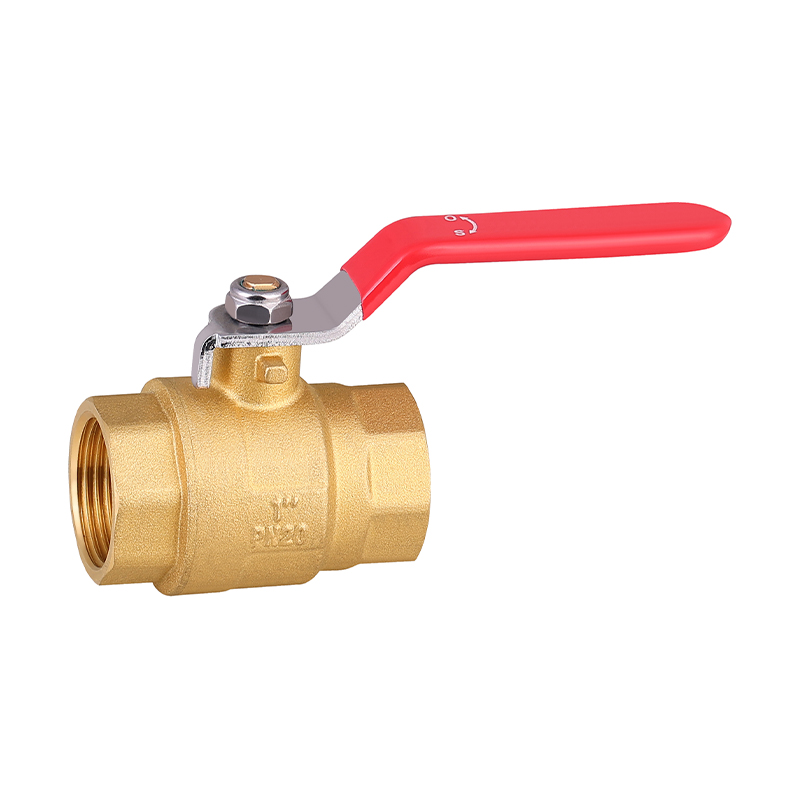 Brass Full-Port Female-to-Female Threaded Ball ValveThe full-port threaded female-to-female baseline for distribution isolation, with brass body and blowout-proof stem; check this model when specifying the standard variant.View Product →
The full-port threaded female-to-female pattern is the sensible benchmark for most distribution work, because it isolates without adding measurable restriction and it can be swapped by any maintenance fitter. Once that baseline is fixed, the remaining variants are chosen by installation method rather than by performance.
Port Size, Flow and Pressure Drop
Port class is the most commonly ignored line on a specification, and its cost shows up on the pump curve rather than on the invoice. A reduced-port valve gives up roughly 30 to 40 percent of the nominal bore area at the ball, and because pressure loss rises with the square of flow velocity, that restriction compounds quickly in a system with several valves in series.
The rule of thumb worth remembering: full port for anything carrying the main flow, reduced port for isolation duty on branches where the valve is either fully open or fully closed and the line is generously sized. On a heating riser with four valves in series, moving from reduced to full port can recover a meaningful fraction of head without touching pipe size.
One caution that comes up on site repeatedly — a ball valve is an isolation device, not a balancing device. Leaving one half open to trim flow puts the seat edge directly in the flow stream at high velocity, and the resulting erosion and cavitation damage will destroy the seal long before the valve reaches its rated cycles. If flow control is needed, that is a separate product, and the specification should say so.
Lockable, Magnetic-Lock and Tamper-Resistant Variants
Where a valve controls access to water rather than just flow, the handle becomes a security feature. Keyed and padlockable levers prevent casual operation of a riser isolation valve during maintenance. Magnetic-lock versions go further: the handle free-spins unless a matching magnetic key is applied, so there is no exposed lock to cut or lever off.
These patterns are used widely on water meter inlets, where the objective is to stop unauthorised reconnection or bypass. The engineering consequence is that the locking mechanism sits between the operator and the stem, so the torque path has more parts that can wear. Ask for the cycle test result on the locking mechanism itself, not just on the valve, and confirm the key is supplied one per valve or one per batch — a mismatched key policy creates a maintenance problem for the whole building.
 Brass Magnetic Lockable Ball Valve for Water MetersA forged brass full-port lockable valve operated by proprietary magnetic key, intended to deter unauthorized water meter use and bypass.View Product →
For meter applications, a magnetic-lockable female-to-female valve is usually the right first choice, because it removes the padlock shackle that otherwise rusts, snags and disappears. Angle-pattern locking valves serve the same purpose where the pipe turns immediately at the meter outlet.
Seats, Seals and Temperature Limits
PTFE seats are close to universal in brass ball valves because they are chemically inert, have a low friction coefficient and seal at low torque. Their weakness is deformation under sustained load at higher temperatures, where the seat takes a compression set and the valve stops sealing in the closed position even though it still turns freely.
The elastomer choice follows the same logic. EPDM handles hot water and steam service well and resists ageing, but it swells in contact with many oils and solvents. NBR is the better choice for fuel and oil lines but has a lower temperature ceiling. Neither survives high chlorine concentrations in pool water without a specific grade.
The practical consequence: the headline temperature rating on a datasheet usually reflects the seat and seal combination, not the brass. A supplier that quotes a single temperature range for every variant in a range is telling you something about how carefully the data was prepared. Ask which seat material is installed in the exact model you are buying, and derate the working pressure as temperature rises rather than treating the pressure and temperature ratings as independent.
From Brass Rod to Pressure Test: Reading a Supplier's Production Route
The production sequence tells you more about consistency than any brochure claim. It usually starts with cutting brass rod to billet weight, then forging or casting the body, machining the bore and threads, optionally plating, then assembling the ball, seats, stem and handle, testing, and finally packing.
Each step has a quality consequence. Forging produces a denser grain structure than casting and is preferred at small sizes where wall sections are thin. Precision machining controls both the thread form and the ball-to-seat interference — the difference between a valve that seals at low torque and one that needs a wrench on the handle. Plating adds corrosion resistance but introduces a thickness distribution problem at thread roots. Assembly determines whether the seat is seated squarely. And pressure testing is the only step that verifies the whole chain at once.
Testing practice is where buyers should press hardest. A meaningful shell test is conducted above the rated working pressure — commonly around one and a half times — and held long enough for a slow leak to become visible, with the seat test done separately in both directions. A factory that can show test records by batch, with holding time and rejection rate, is doing something structurally different from one that tests a handful of samples for a photograph. The same applies to equipment: a facility running more than 120 sets of production and testing machinery has the capacity to test rather than to spot-check. Buyers who want a deeper walk-through of the alternative approaches can read this explanation of ball valve manufacturing, materials and supplier selection.
Packaging belongs in this section too, not because it affects performance but because it affects claim rates. Valves shipped loose in a carton arrive with thread damage and scratched balls, and a scratched ball becomes a leak in service. Individual bagging with thread caps is not a luxury on export shipments.
Failure Modes You Can Design Out Before Installation
Field returns cluster around a small number of causes, and most of them are predictable at the specification stage.
- Dezincification. Covered above, and the most expensive to discover late because it looks like a manufacturing defect rather than a material mismatch.
- Thread cracking from over-tightening. Tapered threads cut into a brass body expand it; two extra turns on a wrench can start a hairline crack that only shows under pressure.
- Debris scoring. A chip or a piece of scale trapped between ball and seat scores the chrome and creates a permanent leak path. On any line that is new, or that has had a repair upstream, a filter protects the whole downstream valve set.
- Stem leaks. Usually a worn O-ring or a stem that has been side-loaded by a pipe that does not align.
- Galvanic corrosion. Brass connected directly to stainless or galvanised steel in a wet environment will corrode at the joint unless a dielectric break is used.
- Water hammer and freeze damage. A ball valve closed quickly against a moving column of water produces a pressure spike far above the static rating; the resulting split is often blamed on the casting.
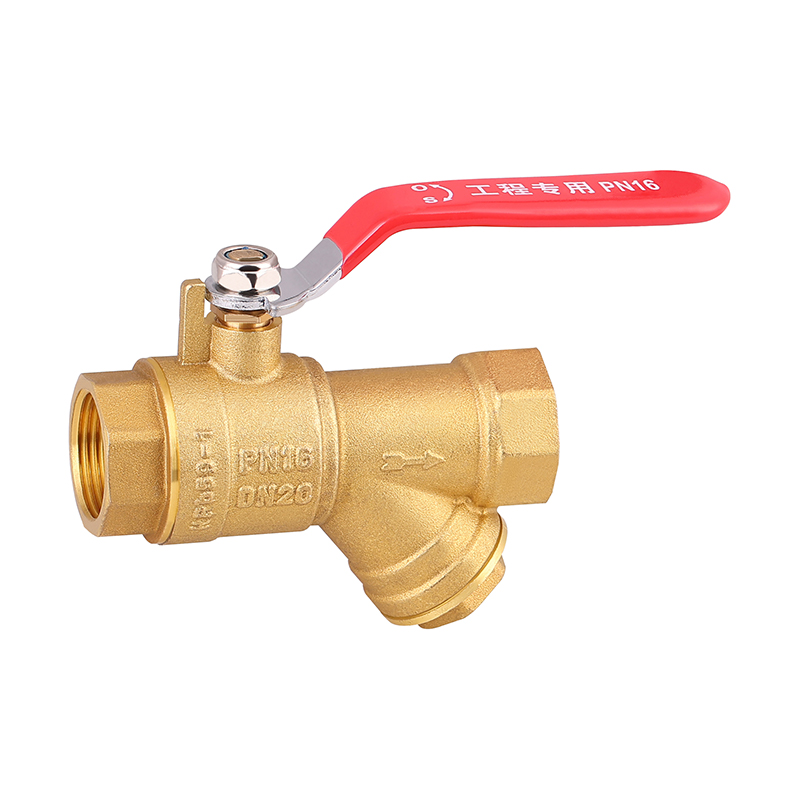 Brass Y-Type Filter Ball ValveCombines full-port brass ball isolation with an integrated Y-type filter to remove debris and protect downstream equipment on dirty or newly commissioned lines.View Product →
On dirty or newly commissioned lines, a combined filter and isolation valve removes the debris problem and one threaded joint at the same time, which is why this pattern is common on meter assemblies and on the inlet side of terminal units.
Installation Details That Protect the Valve
Several failures attributed to valves are actually installation failures, and they are worth writing into the method statement.
- Never use the valve body as a lever to align pipe. Brass is strong in compression and weak in bending, and a distorted body will not seal.
- Apply sealant to the male thread only, leaving the first two threads clean, and use tape sparingly — fragments that enter the bore are the most common cause of a scored ball on a new installation.
- Tighten on the hex flats provided at the valve end, not on the body barrel or the handle.
- Support the pipe within a short distance either side of the valve so that the body does not carry the weight of the run.
- Keep soldering heat away from the seat area, or disassemble the valve before brazing near it.
- Leave the valve in the open position during pressure testing of the line so that debris passes through rather than packing against the closed seat.
- Make sure a locking or magnetic valve remains accessible; a tamper-proof valve behind a sealed panel is a future maintenance problem.
- Operate the valve through a full quarter turn at commissioning and at each service visit, so that a stiff valve is discovered before it is needed.
What Drives Price at the Same Nominal Size
Buyers are often surprised that two half-inch valves can differ by a third in price. The explanation is usually arithmetic rather than margin.
Brass weight is the largest single input, and a full-port valve contains noticeably more metal than a reduced-port one of the same size. Alloy choice adds a premium for dezincification resistance. Machining time per unit falls with better tooling but rises with tighter bore and thread tolerances. Nickel plating adds a process step with its own consumables, waste treatment and inspection cost. Testing adds labour in proportion to how much of the batch is tested and how long each test is held. Locking mechanisms add components and assembly time. Finally, packaging specification, order quantity and the number of variants on a single order all move the unit price, sometimes more than the valve design itself.
The practical takeaway is to compare quotations on a like-for-like specification sheet rather than on the drawing. A cheaper valve is frequently a reduced-port valve in a lighter alloy with sample testing — which may be perfectly adequate for a closed heating loop and entirely wrong for a potable water riser.
Sourcing Checks Before the Purchase Order Goes Out
These are the points worth confirming in writing with any manufacturer, whether the order is a trial carton or a container.
- Confirm the alloy designation and request the composition report for the heat used on your order.
- Confirm whether the stated pressure rating refers to the shell test or the working pressure, and at what multiple the shell test is run.
- Request the test record format and the sampling plan, and confirm whether every unit is seat tested in both directions.
- Ask for the plating thickness range and the salt-spray duration used for acceptance, if plating is specified.
- Verify the thread standard on the drawing, including whether the ends are parallel or tapered, and ask for a gauge check on a sample.
- Ask which seat and O-ring materials are fitted to the exact model number, and request the temperature and pressure derating table.
- Request samples from a production lot rather than a pilot batch, and cycle them by hand before cutting one open to inspect the bore and seat contact.
- Confirm body marking — size, rating, batch — because traceability is what makes a warranty claim resolvable.
- Confirm packaging: individual bagging, thread protection, carton marks, and pallet configuration for the destination port.
- Confirm the commercial basics in writing: order quantity breaks, tooling ownership if a custom handle or marking is required, and the documentation supplied with each shipment.
None of these questions is unusual, and a factory that answers them promptly and consistently is usually the same factory that has its process under control. Hesitation on the pressure-test question, in particular, is informative.
Returning to that weeping valve on the meter manifold: the likely explanation is a combination of a standard brass alloy in slightly aggressive water and a single O-ring stem that had been passing a film of moisture since commissioning. Neither problem is visible on a datasheet that says only "brass ball valve, half inch, female thread."
Specification is cheap; replacement is not. Fix the alloy, the port class, the seat and seal materials, the thread standard and the test regime on the purchase order, and most of the failures discussed here simply stop happening. Everything else — the handle colour, the plating sheen, the carton design — can be decided afterwards, in whatever order suits the project.